
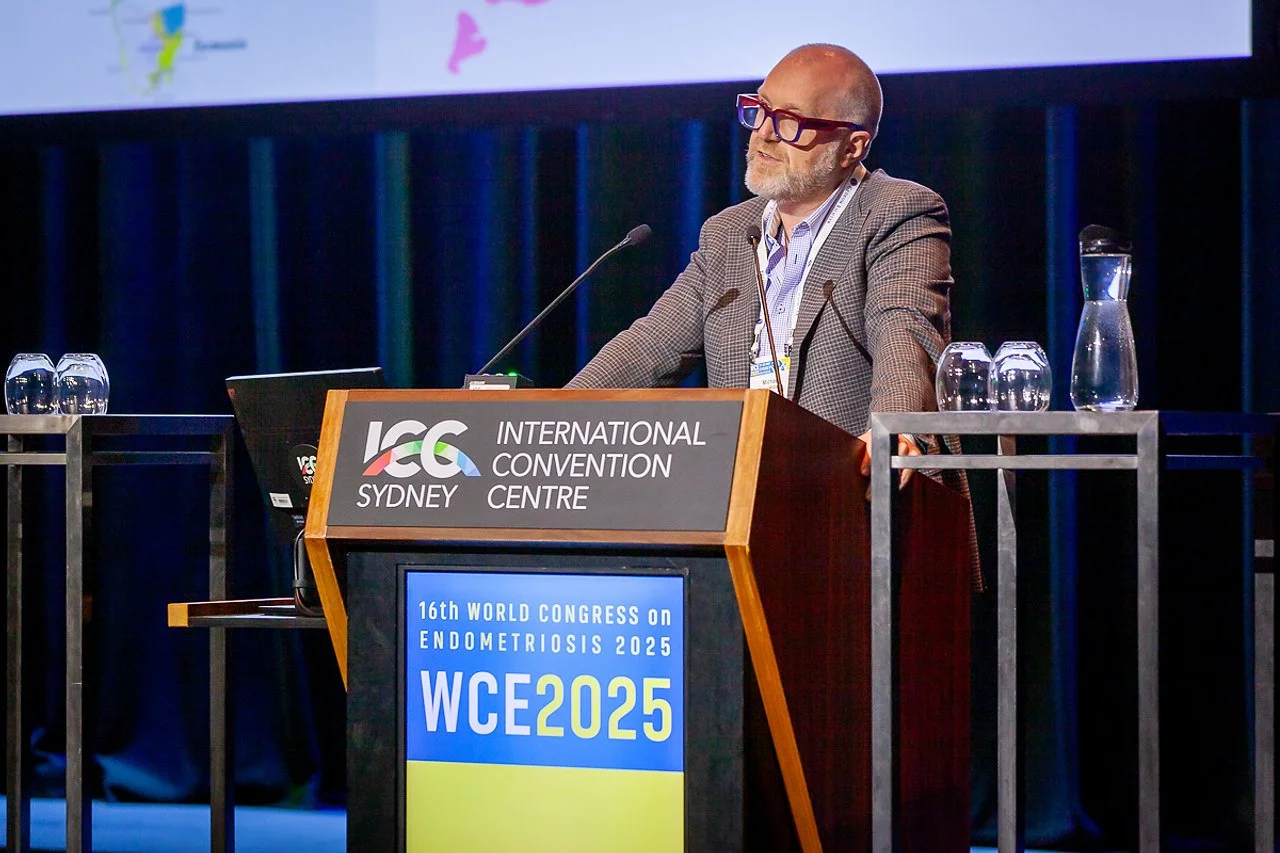
Dr Wynn-Williams presents at the 2025 World Congress on Endometriosis in Sydney
23rd May 2025
This is a transcript of the Invited Address to World Congress on Endometriosis by Dr Michael Wynn-Williams.
Thank you for joining us today to discuss endometriosis in the Indo-Australasian region. Endometriosis has a profound impact on millions of women, girls, and individuals assigned female at birth across Australia, New Zealand, the Pacific, and the broader Indo-Australasian area.
Having worked as a gynaecologist and pelvic pain specialist for 17 years in Australia and the past five years in New Zealand, I offer a unique perspective on an important issue. A widening "pain gap” exists for endometriosis patients in New Zealand compared to their counterparts in Australia.
Today, I will explore this issue by examining our two healthcare systems and government policies related to endometriosis, with an emphasis on the differences in diagnosis and treatment of patients with endometriosis between New Zealand and Australia.
I will also propose practical solutions to address these issues. Finally, I will make a “Call to Action” to my New Zealand and Australian colleagues in support of a New Zealand National Action Plan for Endometriosis.
Australia’s population is 27 million, whereas New Zealand’s is 5.3 million. Endometriosis affects 1 in 10 women and people assigned female at birth, which translates to around 830000 Australians and 120,000 New Zealanders living with this condition.
In December 2017, the Australian Minister of Health, the Honourable Greg Hunt, delivered a national apology to patients with endometriosis. He acknowledged the pain and suffering they have endured due to delayed diagnosis and inadequate treatment. This led to the development of Australia’s National Action Plan (NAPE) for Endometriosis (2018), which serves as a global benchmark, supported by an initial $87 million in federal funding.
The core principles of the NAPE aimed to increase awareness and education, enhance clinical management and care, and foster endometriosis research.
Just some other highlights of NAPE include: The funding of RANZCOG to publish the first Australian clinical guideline on the diagnosis and management of endometriosis in 2021. The latest version of the living guideline was published last week. The National Endometriosis Clinical and Scientific Trials Network The funding of the website EndoZone -providing evidence-based information on endometriosis for patients and clinicians.
A further beneficial outcome of NAPE is its promotion of altruism in endometriosis research. This week alone, $50 million was donated to the UNSW Ainsworth Endometriosis Research Institute.
These achievements are astonishing. Calls are now being made for a second NAPE to continue the fantastic work of the first.
As the federal government becomes more aware of endometriosis, state governments have also increased funding for diagnosis and clinical services, with some conducting inquiries into endometriosis and pelvic pain management.
New Zealand lacks a national strategy for endometriosis and pelvic pain. The 2020 document "Diagnosis and Management of Endometriosis in New Zealand” was released on the NZ Ministry of Health website, which was a positive step, but it received no government funding for execution. Five years later, there has been no progress, and political support remains absent.
In 2023, after extensive consultation, New Zealand launched its first Women’s Health Strategy. This strategy sets long-term priorities to guide the health system toward achieving equity and promoting women’s health. Endometriosis is a key issue where the NZ health system struggles. Unfortunately, since the election of the current conservative government, the strategy has remained inactive on the Ministry of Health’s website.
Australia’s healthcare system offers universal care via federally funded Medicare and state-funded systems. Most centres provide secondary and tertiary care for endometriosis, while regional services are increasingly delivering advanced, multidisciplinary care.
By 2025, about 55% of Australians have private health insurance, with 45% having Hospital Cover. Patients with endometriosis can access radiological services, such as pelvic ultrasounds and MRI. The private system offers multidisciplinary care, including pelvic floor physiotherapy, pain psychology, and pain specialist consultations.
New Zealand’s public health system, managed by Health New Zealand (Te Whatu Ora), was established in 2022 following the COVID-19 crisis to consolidate the 20 district health boards under a single management and governance structure.
Political issues have marred the rollout process. Morale for women's health services is low nationwide, with long waiting lists for specialists and surgeries. Many services struggle with obstetrics and gynaecological oncology care, making benign conditions like endometriosis less of a priority.
Specialist GP services have declined since the COVID-19 pandemic, leading to patients waiting weeks for appointments. Many GPs are burnt out and leaving the profession.
About 37% of New Zealanders have private health cover. Unlike Australia, NZ's private system mainly addresses elective surgery and lacks obstetric and emergency care. Private pelvic floor physiotherapy and pain psychology are available, but funding through health insurance is minimal. Very few private pain specialists exist in NZ, leaving patients with persistent pelvic pain struggling to obtain necessary, timely care.
Since the NAPE, Australia has seen a significant increase in care for persistent pelvic pain, along with the emergence of public and private interdisciplinary pain services. Starting July 1, 2025, a new Medicare item number will enable specialists to treat patients with persistent pelvic pain and endometriosis through consultations of forty-five minutes or longer.
Under the NAPE, 33 specialised GP-led endometriosis and pelvic pain clinics have been established across Australia.
In New Zealand, few dedicated women’s health pain services exist. I'm fortunate to work at one in Auckland, but most centres offer only a general pain service, if any.
The 2023 Australian Institute of Health and Welfare report highlights the underrepresentation of Aboriginal and Torres Strait Islander women in endometriosis specialist clinics and shows more advanced disease at diagnosis. They are less likely to be diagnosed promptly, face cultural stigma, and have limited access to specialist services, especially in remote areas. The National Action Plan calls for culturally safe, trauma-informed care and greater inclusion of Indigenous perspectives, but large-scale Indigenous-led research remains insufficient.
In New Zealand, Māori and Pasifika women experience more severe symptoms and longer diagnostic delays. A 2023 NZ Medical Journal study found that Māori women waited longer for diagnosis and were less likely to receive specialist care. Barriers include socioeconomic disadvantage, systemic racism, and insufficient culturally appropriate services. Addressing these inequities requires culturally safe, community-led care models, focused outreach, and better representation in research and policy.
Australia has advanced in endometriosis research due to significant government funding. The National Action Plan includes a strong research component, leading to many studies and clinical trials. In the last five years, around 450 peer-reviewed papers on endometriosis have been published. Endometriosis Australia has provided over $800,000 in research funding since 2017.
In contrast, New Zealand’s endometriosis research is limited, with only 40 peer-reviewed papers published in the last five years. Funding constraints and the absence of a national action plan have restricted study scope and impact. Although smaller, New Zealand’s research output is significant. Several endometriosis research groups in Auckland, Wellington, Christchurch, and Dunedin strive for quality with limited funding.
RANZCOG manages O&G training in Australia and New Zealand through a six-year program, enabling many trainees to achieve proficiency in level 3 or 4 laparoscopic surgery by its conclusion.
Since 2012, the Australasian Gynaecological Endoscopy and Surgery Society (AGES) has offered the AGES Advanced Training Program for advanced surgical training. There are 34 two-year fellowship positions, with 31 in Australia and 3 in New Zealand. Currently, eight AATP graduates work in Health NZ, mostly in the North Island. Only one AATP graduate serves the South Island from Christchurch, while Dunedin, home to the Otago Medical School, lacks a trained specialist in endometriosis within the public system.
Founded in 2012, Endometriosis Australia offers education, advocacy, research funding, and support groups. Other notable organisations include Pelvic Pain Australia, the Endometriosis Association Victoria, QENDO, EndoActive, and Endometriosis Western Australia. These groups formed the Australian Coalition for Endometriosis (ACE), which has been crucial in lobbying for the National Action Plan. Endo Aus and ACE now receive government funding to support their work.
Founded in 1995 by Deborah Bush and others, the Endo NZ Charitable Trust offers support groups, education, advocacy, and public awareness campaigns. EndoNZ created the world’s first Menstrual Health and Endometriosis program for secondary schools.
Since the NAPE in Australia, Pelvic Pain Australia developed The Periods, Pain and Endometriosis (PPEP Talk®), an educational program for Year 9 students and above. It has expanded rapidly across Australia, now funded by the Federal Government with support from most State and Territory Governments.
In the brief time that I have had, I have shown that endometriosis care in New Zealand is unlike that in Australia, leading to a notable “pain gap” for women between the two countries.
To close the “pain gap” with Australia, the New Zealand Government must:
1. Create a National Action Plan for Endometriosis with specific objectives focused on awareness, research, and both primary and specialised care.
2. New Zealand should retire the outdated endometriosis treatment document and adopt the latest evidence-based Australian RANZCOG Endometriosis Guideline.
3. Develop and expand endometriosis and pain clinics for coordinated care.
4. Focus on clinical & surgical training to build local expertise nationwide
5. Support patient organisations to empower those affected.
6. Ensure equity for Indigenous, Māori, and Pasifika patients through culturally safe, community-led care and research.
In conclusion, I make a Call to Action.
Endometriosis is not solely a woman’s problem; it’s a societal concern. Australia’s advancements demonstrate what can be achieved with political will and funding. New Zealand has a workforce dedicated to clinical care, research, and patient support, but now it requires the necessary funding and prioritisation.
As health professionals, advocates, and policymakers focused on endometriosis, we must advocate for equity, innovation, and compassion. United, we can ensure that no one has to wait a decade for care, regardless of whether they reside in Auckland, Christchurch or Invercargill.